This article may contain affiliate links.
Updated: March 24, 2026
Mtskheta is one of the easiest and nicest day trips from Tbilisi. It’s just over 20 km away and, although the town is small, it’s packed with some of the most important places in Georgia’s history and religion.
Here you’ll find medieval monasteries, spectacular views over the meeting point of the Kura and Aragvi rivers, and a small old town that’s perfect for a relaxed stroll.
In this guide I cover what to see in Mtskheta, the most important monasteries, how to get there from Tbilisi, and a few tips to plan your visit without overthinking it.
✅ Day Trip to Mtskheta, Jvari, plus Uplistsikhe and Gori: the most popular.
✅ Tour to Mtskheta and Jvari: the most budget-friendly option.
✅ Day trip to Mtskheta, Ananuri and Kazbegi: the most spectacular.
Mtskheta: a bit of history
Mtskheta is the oldest city in Georgia and was the capital of the kingdom for centuries. In the 6th century, the capital was moved to Tbilisi because it was easier to defend. Even so, Mtskheta remained one of the most important religious centers in the country.
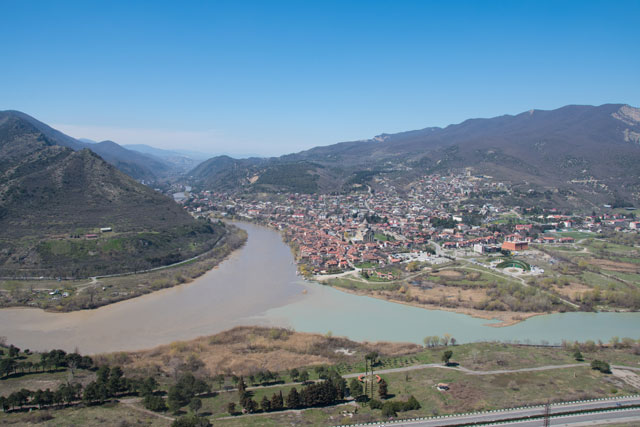
The city sits in a very special spot: right where the Kura and Aragvi rivers meet. From the top of Jvari Monastery you can clearly see this confluence—one of the most famous views in Georgia.
Mtskheta also plays a key role in the history of Christianity in the country. This is where Georgia officially adopted Christianity in the year 337, which explains why you’ll find so many historic churches and monasteries in the area.
Because of this remarkable group of medieval religious buildings, Mtskheta was declared a UNESCO World Heritage Site in 1994. Specifically, the protected monuments are three: Svetitskhoveli Cathedral, Samtavro Monastery (both inside the city), and Jvari Monastery, which sits on the hill right across from town.
What to Do in Mtskheta
1. Jvari Monastery
Jvari Monastery is one of the most famous places in Georgia and has the best views over Mtskheta. From up here you’ll see the meeting point of the Kura and Aragvi rivers—one of the country’s most iconic postcard views.
It was built on Mount Jvari, about 656 meters above sea level, right on top of a cliff.
🔹 History
According to tradition, Saint Nino placed a cross at this spot in the year 545, when there was still an ancient pagan temple here. At the end of the 6th century, the church you see today was built.
The name literally means “Monastery of the Cross,” referring to the large wooden cross inside, which is believed to have miraculous powers.

If you travel around Georgia, you’ll notice many churches dedicated to Saint Nino. And that’s no coincidence: she was the one who spread Christianity in the country and converted King Mirian, the first Christian monarch of
🔹 Architecture
The church has a tetraconch layout plan, with four apses arranged around a central space. The interior is fairly simple, which is quite common in many old Georgian churches.

🔹 Jvari Tunnels
Another curious detail is the underground tunnels that once connected the monastery with Svetitskhoveli Cathedral in Mtskheta and even with other monasteries in the area.
It’s believed they were used to move and protect sacred relics, including the famous robe of Jesus that is kept in the cathedral.
Today these tunnels are closed to the public, as they need restoration.

✔️ Practical Info:
- Opening Hours: 9:30 – 17:30
- Best time of day: If you can, try to visit at sunset.
- Polyphonic chants: on Sunday mornings there is mass and you can hear traditional Georgian polyphonic singing.
🔸 How to get from Mtskheta to Jvari
- Driving: the road is in good condition and well signposted. There’s parking next to the monastery and it costs 5 lari.
- Taxi: it costs around 15–20 lari if you negotiate a bit, and the ride takes about 20 minutes.
- Bus: during the summer there is a bus; ask for more details at the Mtskheta Tourist Office, which is near the cathedral.
✅ Friendly Tip: Don’t forget to get travel insurance for your next adventure. I recommend Heymondo,—it’s super comprehensive, and with that link, you’ll get 5% off.
2. Svetitstkhoveli Cathedral
Svetitskhoveli Cathedral is the most important monument in Mtskheta and one of the most important religious sites in Georgia.
It was built in the 11th century and for centuries it was the largest church in the country, until the Tbilisi cathedral opened in 2004. Even so, it remains one of the most sacred places for Georgians and an important pilgrimage site.

The name Svetitskhoveli means “pillar of life.” It’s linked to an old legend that says the robe of Jesus, brought from the Holy Land, is kept here. This relic is the reason the cathedral was built—and why it holds such religious importance.
🔹 Coronations and Tombs
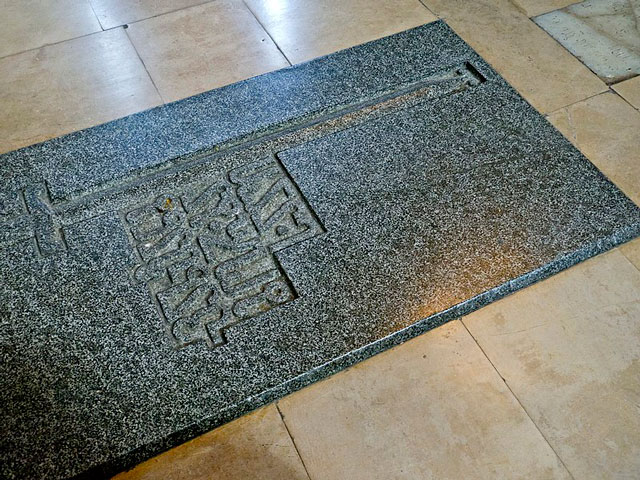
Throughout history, this cathedral was used for royal coronations and as the burial place of several Georgian kings. It’s believed that ten monarchs were buried here, although today only six tombs have been identified near the altar.

One of the most famous is the tomb of King Vakhtang Gorgasali, considered the founder of Tbilisi. Interestingly, his tomb goes pretty much unnoticed inside the church (photo below).
🔹 Frescoes and Weddings
During the Soviet era, many of the frescoes were covered or damaged, but the interior still preserves much of its historical and artistic value.
These days it’s quite common to see weddings in the cathedral, especially on weekends. If you’re lucky, you might even spot a bride wearing the traditional Georgian dress (like the one in the photo below 😍), which adds even more atmosphere to the place.

✔️ Practical Info:
- Opening Hours: 9:00 a 20:00
- Entrance Fee: free, just like the rest of the monasteries and churches mentioned in this article. If you can, leave a small donation to help with the maintenance of the site.
- Religious services: Saturdays from 17:00 to 20:00 and Sundays from 9:00 to 13:00. Tourist visits are not allowed during these times.
3. Samtavro Monastery
Samtavro Monastery is another important place to visit in Mtskheta. It’s a small religious complex with a lot of history—and it’s still active today.
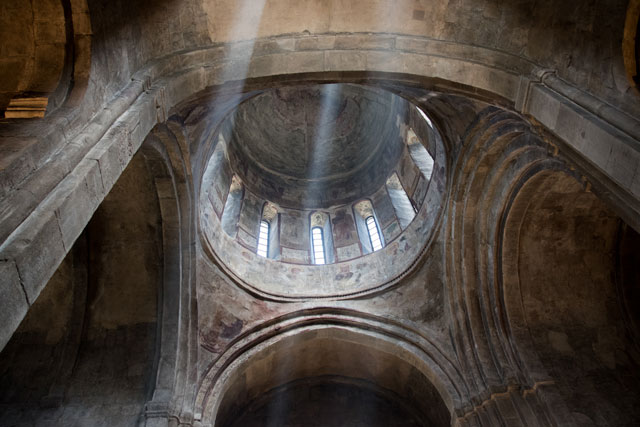
The complex is made up of several buildings:
- The main church. It was built in the 4th century and, according to tradition, stands on the spot where Saint Nino stopped to pray. Inside the church are the tombs of King Mirian and Queen Nana, the first Christian monarchs of Georgia. There’s also the sarcophagus of Saint Gabriel, one of the most beloved saints in the country.
- The Makvlovani Chapel. A small chapel located to the right of the entrance. It also dates back to the 4th century, and its name means “miraculous bush.” It’s tiny, but worth a quick look.
- The bell tower. A three-story tower built in the 13th century, located at the back of the complex.
- The cemetery. Located near the entrance and behind the church.
- The nuns’ convent. A community of nuns dedicated to Saint Nino currently lives in the monastery.
- A small religious souvenir shop.

🔹 Saint Gabriel
The monastery is also a pilgrimage site for many Georgians, especially because of Saint Gabriel.
Gabriel Urgebadze was a monk who lived in the monastery. During the Soviet era, he was put on trial and sent to a psychiatric hospital for several months after burning a Lenin banner.
A few years after his death, he was canonized. Since then, many believers visit his tomb for its miraculous healing powers.
- Opening Hours: 9:00 a 19:00
4. Shiomgvime Monastery
Shiomgvime Monastery is one of those places that almost nobody visits and, for me, it’s one of the most interesting places to visit in Mtskheta. It’s about 12 km from from the city, tucked between cliffs and surrounded by a pretty spectacular landscape.

The name Shiomgvime means “the cave of Shio.” The monastery was founded in the 6th century by Shio, one of the so-called Thirteen Assyrian Fathers—a group of monks who arrived in Georgia to spread Christianity.
⭐ Related article: Visit to the David Gareja Monastery (from the most famous Assyrian father in Georgia).
For centuries it was one of the most important monastic centers in the country and at one point it housed up to 2,000 monks. Today the complex is much smaller, but it still has a very special atmosphere—partly because there are usually very few visitors.
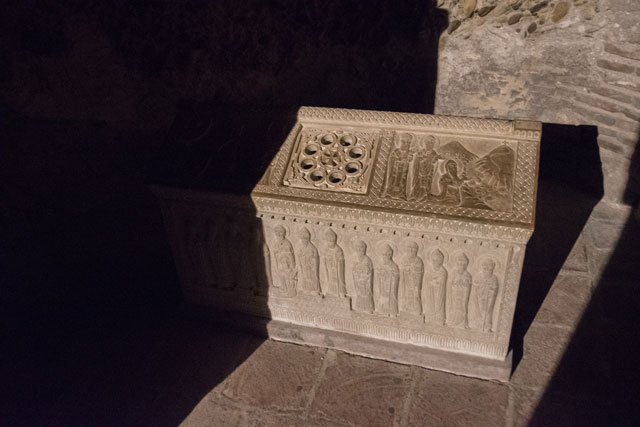
The complex is made up of several buildings:
- A church near the entrance where Shio’s sarcophagus is located. To see it, you have to go through a small corridor to the left of the altar. By the way, it’s quite dark in there—I could barely see where I was stepping. 😅
- A small old bell tower that you reach by climbing some stairs along the side of the church.
- The main church, which preserves very colorful frescoes inside and is worth taking your time to visit.
- In front of the church there are several centuries-old olive trees that, according to tradition, were brought from Jerusalem.

🔹 Caves, eagles and a chapel
If you look up at the cliff, you’ll also see several caves carved into the rock. In the past, they were used by monks as places of retreat.
This area is also a nesting spot for eagles, so if you look up at the sky, you might see one flying over the valley.
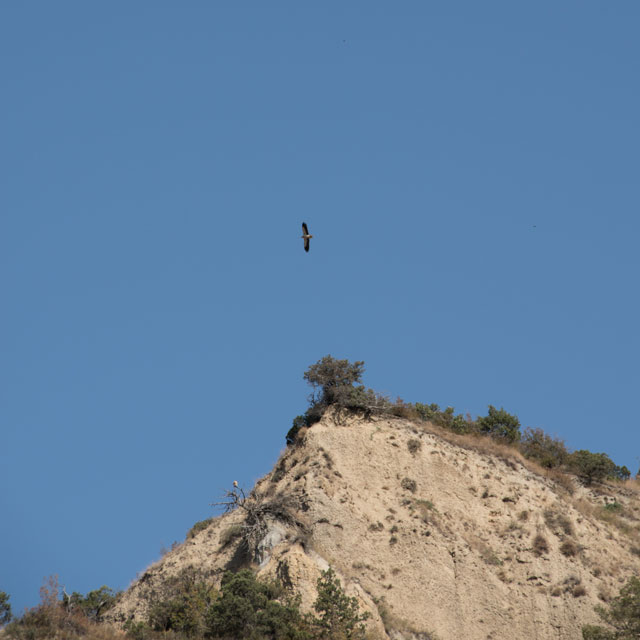
A curious little detail: if you leave the monastery and continue along the road for about 350 meters, you’ll find a small path that leads to a tiny chapel. It was built on the spot where the Virgin Mary appeared to Shio.
- Opening Hours: every day from 10:00.
🔸 How to get from Mtskheta to Shiomgvime
Shiomgvime Monastery is about 12 km from Mtskheta, in a fairly isolated and little-visited valley.
When I went, I spent more than an hour there and barely saw anyone. Only a small group showed up just as I was leaving. That said, on certain religious dates it can attract quite a few pilgrims.
There is no public transport to this monastery, so your options are:
- Driving: the trip takes about 20 minutes. The road is narrow in some sections, but it’s in good condition and the valley views are worth it. There’s a free parking area outside.
- Taxi: you can negotiate with a driver to take you there, wait while you visit the monastery, and then bring you back to the city. The round trip usually costs between 15 and 25 lari, depending on the waiting time. There are taxi stands in the center and in front of Samtavro Monastery.
5. Old Town
Although Mtskheta is a small city, its old town has plenty of charm and it’s worth spending some time wandering through its streets. The atmosphere is calm—almost village-like.
The liveliest area is around Svetitskhoveli Cathedral, where you’ll find a few small streets with shops, cafés, and restaurants.
🔹 Market
Next to the cathedral wall there’s a small street full of souvenir stalls and shops. They sell a bit of everything: handicrafts, Georgian wine, chacha (the country’s traditional spirit), spices, sweets, and a few carpets.
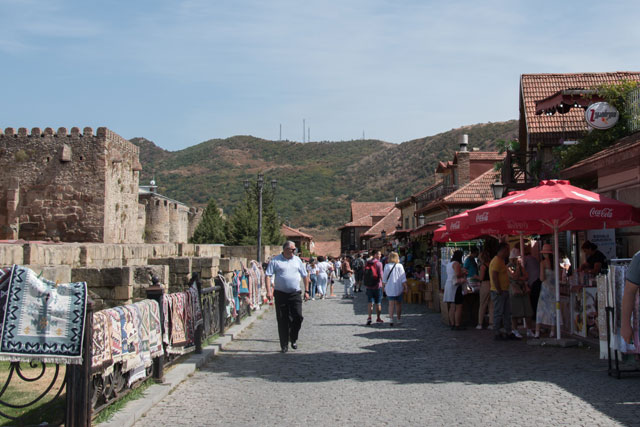
The market isn’t very big—barely about 200 meters long. Still, it’s a nice place to browse for a while or pick up a travel souvenir.
Just keep in mind that prices are usually higher than in Tbilisi, since it’s quite touristy. And one more important detail: many stalls only accept cash.
From this same street you can also see, if you look toward the hill, Jvari Monastery up above.

🔹 Boat ride
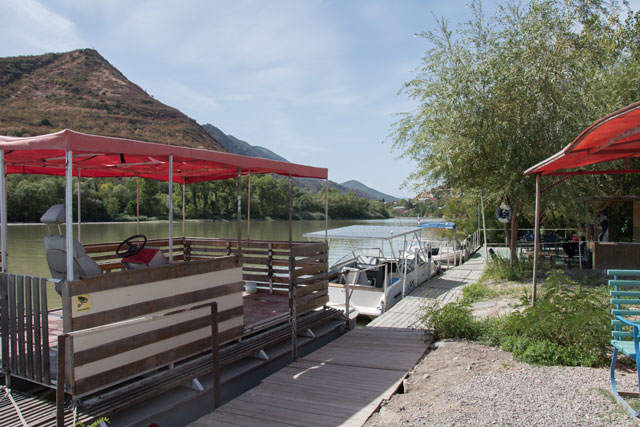
You can also take a short boat ride on the river; I’ve marked the departure point on the map. Although I have to admit… I didn’t try it myself.
👍 My two cents: If you want to stay connected in Georgia, 🤳 I recommend getting this eSIM for Georgia. Click on that links for a 5% discount.
6. Soviet Mosaic
This mosaic is one of those curious little spots you can check out in Mtskheta. It won’t take much time, and you can easily stop by on your way past.
It’s a large open-air mosaic from the Soviet era that represents the so-called “Tree of Life,” a symbol that appears often in Christian tradition.
The mosaic dates back to 1973 and was placed on the old cinema building, which has since been fully restored and turned into what is now the Mtskheta Archaeological Museum.

7. Roman Bridge
Pompey’s Bridge is one of the oldest remains preserved in Mtskheta. It was built by the Romans in the 1st century BC during the military campaign of General Pompey the Great.
For centuries, it was the only access route to the city and part of an ancient trade route connecting different areas of the Caucasus.
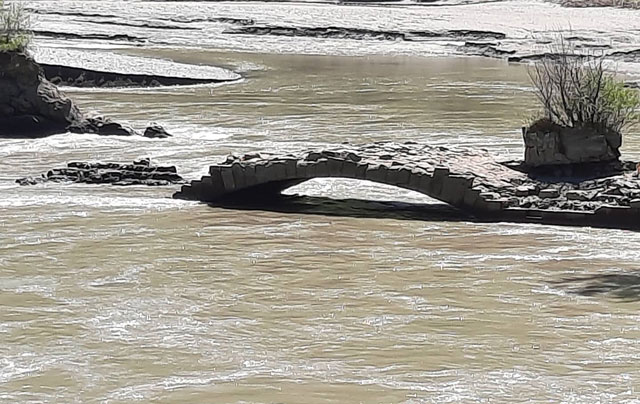
Today, the bridge is partially submerged underwater due to a dam built in the 20th century, so only a few remains can be seen from the riverbank.
It’s not exactly a must-see, but it does have historical interest and can be a quick stop if you head down to the river during your visit to Mtskheta.
8. Medieval Fortress
Bebristsikhe Fortress sits on a hill on the outskirts of Mtskheta and, for centuries, it was one of the defensive structures protecting the city.
It’s believed to have been built around the 9th century, although some historians think it could be even older.

Today, the fortress is in ruins, with only a few walls and towers still standing. That said, the views from up there are pretty good.
Getting there isn’t exactly the easiest, though. I’d recommend visiting if you have some extra time and enjoy exploring old ruins.
Map
Visiting Tips
Most of the places to see in Mtskheta are active churches and monasteries, so keep the following in mind:

- Dress code: For visits, clothing should be respectful. You’ll need to cover your shoulders and knees—this applies to both men and women. You can also bring a scarf to cover up before entering.
- Head covering: In many Georgian churches, women are expected to cover their heads with a scarf when entering. Sometimes scarves are available at the entrance, but it’s better to bring your own.
- Respect: Remember these places are still used for worship. If there’s a mass or people praying, it’s best to move quietly and avoid making noise.
- Photos: In most churches, photos are allowed, but flash is usually not permitted. In some cases, you may be asked not to take photos in certain areas.
- Donations: Entrance to churches is usually free, but it’s common to leave a small donation for the upkeep of the site. It’s not mandatory, but always appreciated. These places also help support people with fewer resources.
How to get to Mtskheta from Tbilisi
Mtskheta is only 20 km from Tbilisi, so getting there is quick and easy. These are the best options:
- Marshrutka (minibus): from Didube station, it takes about 30 minutes and costs 2 lari.
- Taxi: it will cost you around 20–25 lari for the ride.
- Driving: the most practical option if you’re traveling around Georgia. I recommend this website to rent a car from reliable and affordable local companies.
- Day Trip: perfect if you don’t want to overthink it. There are several options— this one includes Gori and the cave city of Uplistsikhe. Or this other one to Mtskheta and Kazbegi, one of the most spectacular areas in Georgia.
⭐ Related article: Guide to Kazbegi and Ananuri
Where to Stay
Spending a night in Mtskheta can be a great idea if you want to travel at a slower pace or if you’re planning to continue your trip to other regions of Georgia like Kazbegi or Kakheti.
The city is small, but there are quite a few good-value accommodation options, many of them close to the old town and the cathedral.
These are the ones I recommend:
- € Old Capital: right next to the cathedral, with fantastic views from the terrace.
- €€ Magdalena: very charming, with delicious and generous breakfasts—easily the best value for money.
🤑 If you want to save on your next adventure, use this link from Booking to get 15% off your stay.
Where to Eat
In the old town area and around the cathedral, you’ll find several options.
In many restaurants, you can try classics like khachapuri, khinkali, or grilled meat paired with Georgian wine.
⭐ Related article: 9 Best Traditional Georgian Dishes and where to eat them.

One place I recommend is Ornament Express—it’s my favorite restaurant in Mtskheta. Their lobio is delicious—a bean stew served with fried mchadi bread—and here they also add jonjoli (photo above).
The trout and the lobiani are also finger-licking good.
FAQs
Yes, absolutely. Mtskheta is one of the most important places in Georgia’s history, and it’s also very close to Tbilisi. In a small area, you’ll find some of the country’s most important religious monuments.
If you plan to visit the cathedral, stroll around the old town, and go up to Jvari Monastery, half a day is enough.
If you also want to visit Shiomgvime Monastery, I recommend setting aside a full day.
Spring and autumn are the best seasons. The weather is pleasant, and the scenery is at its best.
In summer, temperatures can get quite high at midday, while in winter it’s colder—though the upside is that there are usually fewer tourists.
Final Thoughts
I hope this guide to the best things to do in Mtskheta helps you explore this beautiful city full of history.
I’ll leave you with a travel quote I really like:
"The world is a book, and those who do not travel read only one page."
Saint Augustine
If you have any questions, leave me a comment below and I'll help you as much as I can. If you found the article useful, share it with other travelers. Have a good trip! 😘
More about Georgia




Hi, I’m Andrea, creator and author of Viajeros Activos (Active Travelers). I write about Southeast Asia, the Caucasus, and Europe. I’m a full-time traveler, passionate about good food, and always looking for new adventures.
Hello! I'm glad I discovered this blog.
Now a few questions:
Are the temperatures in these places Mskteha very freezing at the end of October?
More or less how many degrees is the lowest?
I'm thinking of going to Georgia that season and I'd like to know what the temperatures are like. I also hope it doesn't rain too much by then.
Another question: is it worth buying a VPN?
First I will go to Azerbaijan and then I will be in Georgia, maybe I will take one of those day tours to Armenia that they offer.
Get your Guide and those companies.
Greetings
Hello Sandra
I'm glad the information is helpful to you!
At the end of October it is not as cold as during the Georgian winter, but it is still cold.
When I lived in Tbilisi, I turned on the heating in late September/early October; in Mtskheta, the temperature is a little cooler.
During the day, temperatures will hover around 10 degrees Celsius (50 degrees Fahrenheit), enough to warrant wearing a coat. At night, temperatures can drop to 0 degrees Celsius (32 degrees Fahrenheit).
Bring a coat, gloves, and a hat, as well as some thermal clothing if you're not used to the cold. This will also be useful in mountain areas that will already be covered in snow.
I would recommend a VPN if you're going to be in Georgia for a while and connect to a Wi-Fi network. Otherwise, you won't need it.
A good (and economical) alternative is to buy a local SIM card that you can use whenever you have to make a transaction where important information could be compromised. You can also use the SIM card as a hotspot with other devices. I don't know if you've read my guide on tips for traveling to Georgia, but I'll leave it here, maybe it'll help. I talk about SIM cards and other topics there.
By the way, there are day tours for Armenia that take you to the monasteries along the border, but if you want to visit Yerevan or other places, you'll have to go to Armenia and spend a few nights there.
Enjoy it a lot!